
When Everything Goes Wrong — and It’s a Good Thing
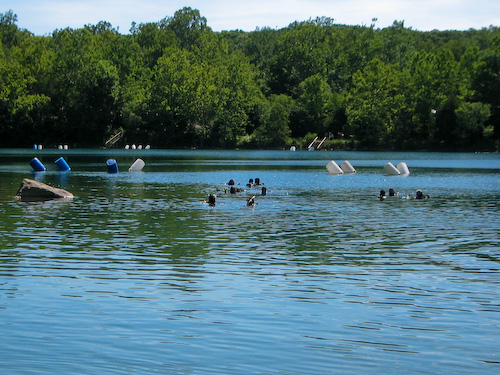
Divers at Millbrook Quarry (Haymarket, Virginia)
As a young teenager, I finally got my wish: Scuba lessons for my 15th birthday! My lessons were in a moldy YMCA pool in suburban Philadelphia, and my first open water dive — my checkout dive — was in a quarry in Reading, Pennsylvania in the balmy month of December. Air temperature 36 degrees F, water temperature 40 degrees. My wetsuit was too big, was full of holes, and to this day I don’t think I’ve ever been so cold. In those primitive days of the early 70s, we didn’t use buoyancy compensators (BCs), vests that you can fill with air from your tank to keep you afloat at the surface or keep you neutrally buoyant at depth. Rather, we used “horse collar” safety vests — virtually identical to what the flight attendant demonstrates the use of for the “unlikely event of a water landing.”
To put air into your vest, you had to grip the tip of the inflator tube with your teeth, push it in and blow until it was full. There were also two CO2 cartridges which would inflate the vest as a backup, but we were warned not to use them unless it was an absolute emergency since replacing the cartridges was expensive.
After surfacing following a visit to the highlight of the dive — an overturned milk truck — I realized I had too much weight on my weight belt and could barely tread water. So, I went to blow some air into my vest, but after so much time in the water, my lips were frozen and couldn’t make a seal on the little inflator tube. Try as I did, the air simply escaped through my lips, making a horrific version of the sound children make to imitate propeller airplanes, so loud that it got the attention of some curious onlookers on shore. The combination of this ridiculous exercise, coupled with trying to tread water in an overweighted condition, exhausted me in no time. I feared the wrath of my instructor for my next decision, but I chose to live and “popped” my CO2 cartridges. In an instant was floating comfortably in a full vest, cold and exhausted, but euphoric. I remember the feeling finally coming back to my feet in a McDonald’s nearly two hours after we left the quarry.
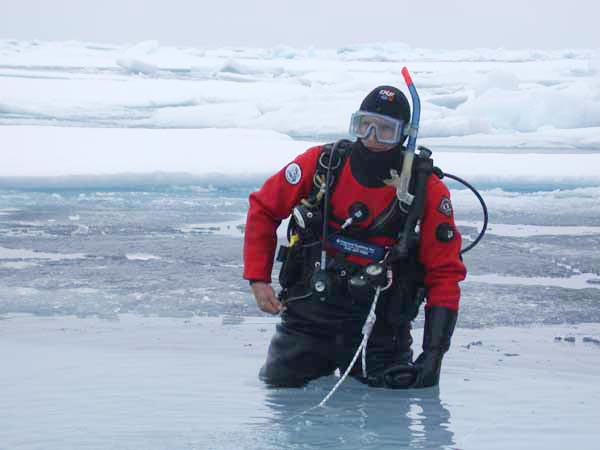
NOAA Diver Wearing a Drysuit
I guess I shouldn’t be surprised that, with the exception of the years I lived in California, I’ve been almost exclusively a warm water diver in the nearly 35 years that have passed since that cold day at the quarry, spending 90 percent of my underwater moments in the tropics. But in preparation for this week’s Bering Sea Expedition led by Greenpeace, the cold water — really cold water — awaits us, and while our expedition plan has us exploring from the comfortable, dry helm of small submarines, we will also be scuba diving during part of the trip at some of the shallower sites, and I will be serving as underwater videographer. This means wearing a drysuit, and for that I needed specialized training and a certification. Unlike a wetsuit, which does allow some water to come between you and your suit, a drysuit is completely sealed, keeping you warm and dry inside. The suit itself has little or no thermal properties — you’re kept warm by the thermal underwear you wear underneath. I was excited about finally getting my drysuit certification, but it meant two open water dives in my first quarry dive in nearly 35 years. The first of those dives was a humbling flashback to 1973.
Following the lecture by Technical Instructor, Brian E. McMillan from the top-notch dive shop, Adventure Scuba Company in Chantilly, Virginia, we suited up and walked down the ramp into the waters of Millbrook Quarry in Haymarket, Virginia, along with NAUI Dive Master Jeff McManus and two other students. As I entered the water, I was concerned to feel what felt like water rushing into my drysuit. Brian suggested that I might be feeling my sweat being chilled by the cool water, but it ultimately became clear that something was amiss. Now, if you find yourself putting on a drysuit, it’s important to remember one minor detail: There are TWO zippers, and only the inner zipper seals the water out. In my haste to get into my suit, I had only zipped the outer zipper, so in the first minute of my dive, I managed to convert my drysuit into a very wet wetsuit, proving that even experienced divers are capable of really stupid acts.

Adventure Scuba Company Technical Instructor Brian E. McMillan
Jeff patiently zipped me up and we continued…for about 20 seconds. I was flashing back to 1973, unable to stay afloat on the surface. Air was screaming out of one of my BC valves, and even using the auto-inflator to pump air in resulted in nothing more than a geyser of bubbles. Yes, another self-inflicted act of stupidity. I had forgotten to replace an o-ring in my BC after cleaning it recently and hadn’t fully tested it before leaving for the quarry. My BC was useless
Fortunately, since drysuits have some air in them, they can help you maintain buoyancy. Like a BC, they have an inflator hose, so at the push of a button, you can puff air into your suit. Brian and Jeff, ever patient (though I’m sure by now were really having some doubts about their problem student) suggested that I continue the dive using the drysuit to control my buoyancy.
So down we went to the underwater platform, where we worked on several drills, including buoyancy control, connecting and disconnecting the inflator hose (an important skill should the valve become stuck). We also practiced recovering from an inverted position where air in the feet of your suit causes you to hang upside down. All was fine, except that as the dive progressed, my weightbelt — which, in keeping with tradition, was overweighted — kept sliding further and further down, ending up at my knees. Try as I did, I couldn’t secure it properly atop my bulky drysuit. It was about then that I noticed that my expensive dive computer had flooded. When the dive finally ended, walking back to the cars was slow as I was probably carrying an additional 50 pounds — of water — in my suit. My integrated booties looked like clown shoes, ballooning with water with each step.

Jeff McManus, NAUI Dive Master, at Adventure Scuba Company
After our surface interval, a burger, another lecture, and some sunshine to partially dry out my thermals, it was time for dive number two. The training of my first dive prepared me well: TWO ZIPPERS! I lightened my weightbelt, and Jeff outfitted my BC with a spare o-ring. I found the “sweet spot” for my weightbelt and it didn’t budge. Everything worked perfectly. I was warm, dry, perfectly trimmed, and beyond happy. Now I understood the appeal of drysuit diving — amazing how much different the experience is when everything works. The water at the bottom of the quarry was very chilly, but I stayed warm.
I expressed my gratitude to Brian and Jeff for their patience and assistance. These are two terrific and highly professional instructors. Both humbly replied, “that’s what we’re here for” and emphasized how important it is to learn to deal with these problems, and to do so in a quarry, not the Bering Sea. They’re absolutely right, and on the drive home from the quarry yesterday, I caught myself thinking what for nearly 35 years would have been unthinkable. “I’d like to dive here again.”


Leave a Reply
Want to join the discussion?Feel free to contribute!