
Cuba Offshore Oil Drilling: Why We’re Not Ready
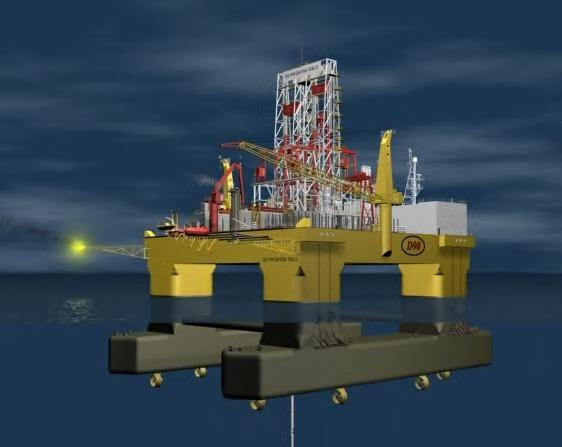
The 53,000-ton the Italian-owned, Chinese-built Scarabeo 9 is a state-of-the-art, semi-submersible ultra-deepwater drilling platform capable of working in up to 12,000 feet of water depth with a 50,000 foot (9.5 miles) drilling depth capacity. The platform has accommodations for full-time support of up to 200 workers. (Source: “Background on Scarabeo 9” in CubaStandard.com by Jorge Pinon,)
As I write this, a massive offshore oil platform makes its way around the southern tip of the African continent on its journey from Singapore to its final destination within 50 miles of some of our nation’s most environmentally sensitive waters. By year’s end, it will be in operation to drill the first exploratory well more than a mile deep in Cuban waters.
Shortly after Cuba’s discovery of offshore oil more than six years ago, I met with my colleagues at the University of Havana who had just been briefed by the state-run oil company, Cupet (Cubapetroleo). Models predicted that 90 percent of oil from a blowout would be transported northward to the Keys and up along Florida’s East Coast, impacting Miami, Ft. Lauderdale and beyond. The question is, of course, are we ready to deal with such a catastrophe?
Few people realize there was a full-scale “drill” conducted in the Gulf of Mexico testing the preparedness of Cuba and the United States to respond to an oil spill of international dimensions. It was called Deepwater Horizon. In mid-May 2010, models predicted oil from the spill would be transported through the Florida Keys and up the Eastern seaboard of the United States. The same models also forecast that before reaching the Keys, the oil would be transported due south, directly impacting Cuba’s northwestern coast, an area rich with coral reefs and Cuba’s prime fishing grounds. Cuban colleagues in Havana contacted me, desperate for information.
I called a meeting at The Ocean Foundation offices in Washington, DC and we were joined by the State Department, along with others by telephone, including the U.S. Interests Section in Havana, including a U.S. Coast Guard official stationed there. I was impressed by how concerned all involved were and how committed to helping Cuba they were should oil impact its waters. But once the conversation moved to specifics and the logistics of actually providing equipment and personnel, it became profoundly clear that there was no plan and no clear way for these agencies to navigate the labyrinth of regulations and mountains of paperwork necessitated by the U.S economic embargo against Cuba, in place for more than 50 years.
A few weeks later, the currents in the Gulf altered course, and the grim scenario predicted by the models did not play out. Cuba was spared, but it became abundantly clear that the lack of formal diplomatic relations has left us unprepared to deal with a large-scale international oil spill involving Cuba, regardless of whether the U.S. is a donor or receiver of spilled oil.
It’s been no secret that Cuba has been planning to conduct offshore oil drilling. On Christmas day 2004, Fidel Castro announced that two Canadian companies had discovered reserves of 100 million barrels in Cuban waters of the Gulf of Mexico. Shortly after I learned the details in Havana a few months later, I briefed then-Governor Jeb Bush’s senior staff in Tallahassee and urged a face-to-face dialogue with Cuba, to at least coordinate on an emergency plan and response should the worst happen. My colleagues and I have been briefing Members of Congress and the Administration ever since, but it has taken all these years ? until the drilling rig is actually on its way and Cuba is weeks away from drilling ? for the Senate to hold a hearing about the issue. The hearing ? which was also focused on offshore drilling in Canada, Russia and the Bahamas ? took place last week.
Yet at the Senate hearing last week, testimony by Michael R. Bromwich, (Director of the Bureau of Ocean Energy Management, Regulation and Enforcement) and Vice Admiral Brian M. Salerno (United States Coast Guard, Deputy Commandant for Operations), made it crystal clear that their respective legal authority to work with Cuba in the event of a spill was anything but clear. Given the proximity of the drilling site to the Keys, and given the swiftness of the currents of the Straits of Florida, we would need to mobilize a response to an oil spill within hours, not days. Both Mr. Bromwich and Vice Admiral Salerno indicated that authorities would need to be granted by an alphabet of agencies, including the State Department, Department of Commerce, Department of Justice, Department of the Treasury, and more. Surely if the legal issues are not dealt with in advance, our best-planned emergency response efforts would be hamstrung by ongoing delays by legal debate and political wrangling.
Unfortunately, not a single Senator was willing to explore the possibility of actually establishing a dialogue with Cuba, despite testimony from oil industry representatives recommending it. Earlier this year, President Obama’s National Commission on the BP Deepwater Horizon Oil Spill and Offshore Drilling, co-chaired by former Senator Bob Graham and former EPA Administer Bill Riley, recognized that we must work with our neighbors in the Gulf, Cuba and Mexico, stating, “It is in our country’s national interest to negotiate now with these near neighbors to agree on a common, rigorous set of standards, a system for regulatory oversight, and the same operator adherence to the effective safety culture called for in this report, along with protocols to cooperate on containment and response strategies and preparedness in case of a spill.” The Commission got it right. There can be no substitute for face-to-face dialogue to set high standards, create an emergency plan and open lines of communication should the unimaginable occur.
To make matters worse, Republican Senators Lisa Murkowski (R-Alaska) and Bob Corker (R-Tennessee) exploited the opportunity to call for opening up more areas in domestic waters to offshore drilling. Senator Murkowski (R-AK) stated, “…it makes no sense for this country to sit stubbornly in between active drilling operations in neighboring waters with our arms folded. It does us no good to complain that offshore drilling is too risky for us to pursue as other nations are clearly very busy reaping its benefits right outside our front door. And yet that position is precisely is what some senators and some groups would advocate, that the us stay out of this business entirely.”
Further, Senator Murkowski claimed that one of the best ways to help the U.S. respond to an international oil spill disaster is to expand offshore drilling in our own waters. Senator Corker picked up on this and put the question to Mr. Bromowich, “The ranking member [Senator Murkowski] mentioned something about the fact that the more we have in the way of resources ourselves involved in exploration, the better we could respond to something that might happen in waters that are nearby. Is that a sensible notion that she laid out, that in fact the more we’re producing and exploring off our own continental shelf, the better we can actually respond to something that’s happening in other countries’ waters?” Mr. Bromwich’s responded, “I think Senator Murkowski is absolutely right in stating that.”
Our leaders must do better — the stakes are too high. The decision to engage with Cuba on this is ours to make. Cuban officials have told my colleagues and me many times that they are willing to meet with our government on this issue. Recently, Oil Spill Commission Co-Chair Bill Riley traveled to Havana to meet with Cuban officials, a meeting that was, by all accounts, thoughtful and productive according to my colleague, Dan Whittle at Environmental Defense Fund who made the meeting possible. There is precedent for Cuba – U.S. governmental cooperation. Our National Weather Service and Cuba’s equivalent agency have collaborated for decades, and there are other such examples. The participation of a NOAA representative at our meeting last fall of the Trinational Initiative for Marine Research and Conservation in the Gulf of Mexico and Western Caribbean (a collaboration between Cuba, Mexico and the U.S.) was a welcome step forward, as was the participation of a NOAA representative at a workshop in Cuba earlier this year.
The lessons of the BP Deepwater Horizon still sting smartly with the consequences of failing to adequately plan for the worst-case scenario. We now have an opportunity to do better. Sometimes neighbors don’t get along with one another. But when something happens that affects the neighborhood, they must rise above their differences and find a way to work together. The waters that unite Cuba and the U.S. are unique in the world and sustain marine ecosystems and wildlife that both nations depend upon. It’s our neighborhood, and it’s still beautiful. We must work with our neighbors to protect it.


Leave a Reply
Want to join the discussion?Feel free to contribute!