• Link to X
  • Link to Facebook
  • Link to LinkedIn
  • Link to Youtube
  • Link to Instagram
  • Link to Pinterest
  • Link to Rss this site
Ocean Doctor
  • About
    • About Us
    • History
    • Board of Directors
      • Dr. Sylvia A. Earle
      • Adam Ravetch
      • Robert Frank
      • Advisory Council
    • Our Team
      • Dr. David E. Guggenheim – President
      • Mary Kadzielski – Program Consultant
      • Sophia Marencik – Conservation Policy Intern
      • Taylor Gordon – Intern
      • Cassidy Haney – Intern
      • Christina Riemer – Intern
      • MJ Hendren – Intern
    • Press
      • Ocean Doctor in the News
      • Media Kit
      • Press Releases
    • Contact
      • Contact Us
      • Submit a Question About Our Cuba Travel Program
      • Subscribe to Our Newsletter
      • Social Media
  • Our Work
    • Cuba Conservancy Program
      • About
      • Considering the Economic Value of Cuba’s Natural Ecosystems
      • Project “Red Alerta”
      • CUSP – The Cuba-U.S. Sustainability Partnership
      • Cuba Environmental Film Festival
      • Cuba Educational Travel
      • Animal Rescue in Cuba
      • More…
    • 50 States Expedition
      • About
      • Adopt a State!
      • Articles
    • Penguin Conservation
      • About
      • Our Film: Disaster at Nightingale
      • Articles
    • Animal Rescue in Cuba
    • More…
      • Protecting the Bering Sea Canyons
      • Sustainable Aquaculture
      • Expeditions
        • Cape to Cape Expedition
          • Articles
          • Track
        • Bering Sea Expedition
          • Articles
          • Track
        • The Ocean Doctor Radio Show
          • Listen Now
          • Subscribe with iTunes
  • News
    • Featured
    • Ocean Doctor in the News
    • Ocean Doctor’s Reflections
    • Action Alerts
    • The Ocean Doctor Radio Show
  • Events
    • Upcoming Events
    • Events Calendar
    • Past Events
    • Book a Speaker for Your Event
  • Travel With Us
    • Travel Opportunities
    • Registration
  • Book a SpeakerDr. David E. Guggenheim is a marine scientist, ocean explorer, submarine pilot, and conservation policy leader based in Washington, DC at The Ocean Foundation where he serves as Senior Fellow and Director of its Cuba Marine Research and Conservation Program. He also hosts The Ocean Doctor Radio Show. Dr. Guggenheim was inducted into the Explorers Club as a National Fellow in 2008. An accomplished public speaker, Dr. Guggenheim offers a unique perspective ? from a tiny submarine 2,000 feet beneath Alaska’s Bering Sea to the hallways of Washington, DC ? on the wonder of the oceans around us and the critical issues they now face. In early 2009, Dr. Guggenheim embarked on a special ?expedition? to deliver speeches to tens of thousands of students in all 50 U.S. states, the Ocean Doctor’s ?50 Years ? 50 States ? 50 Speeches? Expedition. In Washington, DC, Dr. Guggenheim is a leader in conservation policy, on important issues including global warming, coral reefs, sustainable seafood, and environmental education and is actively involved in international environmental issues. Read Dr. Guggenheim’s full biography? ? Dr. Guggenheim is a regular spokesperson on ocean issues and has been featured on ABC’s Good Morning America, CNN, MSNBC, BBC,?
  • Support Us
    • Make a Donation
    • Ocean Doctor Gear
  • Click to open the search input field Click to open the search input field Search
  • Menu Menu
Blog - Latest News
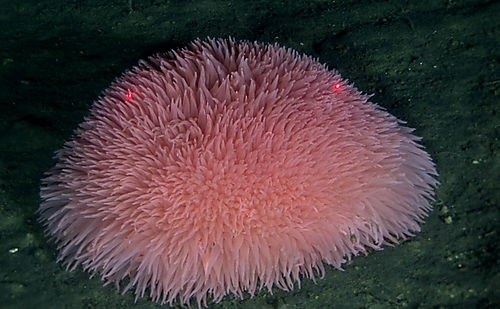
The sublimely pink deepwater coral, Swiftia pacifica

Where Condos Fall from the Sky

August 5, 2007/in Bering Sea Expedition, Conservation, Featured, Ocean Doctor's Reflections/by Ocean Doctor
The sublimely pink deepwater coral, Swiftia pacifica

The sublimely pink deepwater coral, Swiftia pacifica

They look strange, out of place — and they are. Because they’re not from around here. The odd-shaped stones and boulders that pepper the flat, dark, silty bottom here at nearly 1,800 feet look like meteorites, each surrounded by a wide, shallow crater. They’re not from outer space, but many have traveled a vast distance on Earth — hundreds, perhaps thousands of miles, over millennia. And now my sub is face to face with one of three I’d encounter on our first dive in Zhemchug Canyon yesterday (Saturday) afternoon.

They’re called “drop stones” and it’s icebergs that do the dropping. As glaciers move across the land, rocks become incorporated into the glacial ice. Once the glaciers find the coast, they “calve” into ice bergs and travel vast distances floating upon the ocean, melting along the way and eventually, releasing their rocky payload.

One might think of a rock, even a hefty one, falling to the bottom of the vast Bering Sea as one of the more inconsequential events in the universe. But if you’re tiny, living in a world that’s flat and unprotected from the swift Arctic current ripping by, even a tiny pebble can mean the difference between survival or not. Corals, like the sublimely pink Swiftia pacifica we came across yesterday, appear to be growing right out of the brown silt. But a closer look reveals a small rock or pebble beneath the surface providing a holdfast against the current. If you’re a tiny critter like a shrimp, your only option is to get down into a hole, if you can find one. But holes don’t last forever — the current will eventually sweep them away. You can also try to get yourself up against the downstream side of an object — like a rock — so you’re not swept away with the current. Other than that, there aren’t many options across the flat, nearly rockless landscape of the bottom of this neighborhood in Zhemchug Canyon.
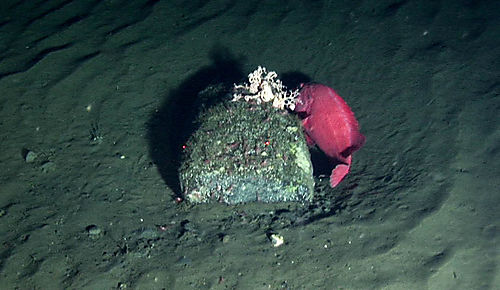
Drop-stone covered with shrimp, a basket star, and a rockfish next door

Drop-stone covered with shrimp, a basket star, and a rockfish next door

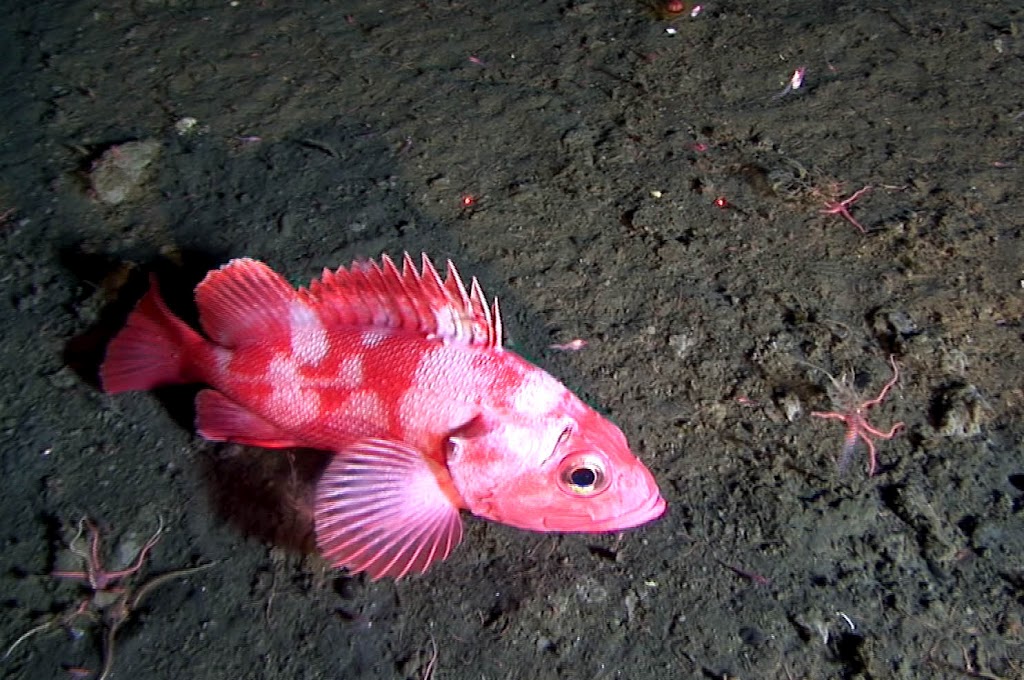
So if one day a huge rock comes a-plummeting out of the sky, it’s like a deluxe condominium suddenly appearing, and the shrimp don’t waste a moment moving in. They covered the lee side of the drop stones I encountered, wall-to-wall. The penthouse was reserved for critters like basket stars, corals, anemones, sponges or hydroids that could attach themselves firmly, then grab prey as they float by in the current. Fish like rocks, too, especially, well — rockfish. The brightly orange-colored shortraker rockfish lay against one of the drop stones. A prehistoric-looking Giant grenadier, perhaps 4.5 feet long, with its long, eel-like tail gently waving in the current, nestled by another. And I encountered the aptly-named bigmouth sculpin by the third.

The halibut who taught me how to become invisible

The halibut who taught me how to become invisible

During my last dive at Pribilof Canyon, I noted flatfish depressions and the fact that they were full of shrimp. Same here at Zhemchug. I was even treated to a flatfish hole digging demonstration by a small halibut that I “encountered” (translation: terrified). He was quite upset at being awakened by a noisy metal object with bright lights pointed at his face, so he swam a few body lengths, then flapped his flat body furiously and kicked silt up onto the top of his flatness until he was (or at least thought he was) invisible. That process, repeated millions of times, means sanctuary for a critical part of the food chain, including the many shrimp I spied enjoying their stay in a flatfish hole. Not only does the hole allow them to relax and not have to fight the current, but NOAA scientist Bob Stone points out that little eddies forming as the current runs by cause food particles to drop out of the water column. So if you’re a shrimp, you can kick back, not lift a claw, and let the food come to you. The current scours shallow craters around the drop stones, so shrimp living there not only get regular food deliveries, but also a high-rise view. I suppose that’s the Bering Sea definition of the good life.
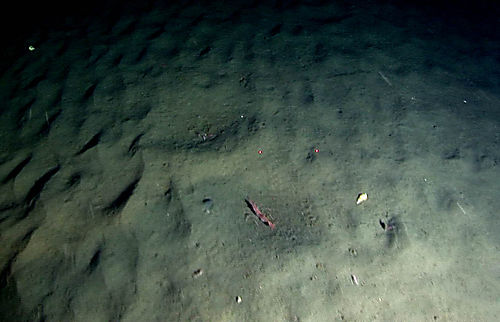
A large, happy shrimp, living the good life in a flatfish hole

A large, happy shrimp, living the good life in a flatfish hole

It’s quite remarkable in nature how little things matter, like where a rock falls or where a flatfish rests. And there are big things in this world that threaten those little things, like taking too many fish from the sea, and global warming, which is already believed to be changing the patterns of the ice pack in this region, along with distant glaciers, and the would-be drop stones they encounter. It’s important for us to think about what it takes — even the seemingly little things — to make an ecosystem work, especially one as wondrous and important as this one. Because if a rock falls in the Bering Sea, and no one is there to hear it, it’s still someone’s condo.
Tags: boulders, Canyon, OceanDoctor, Zhemchug, zhemchug canyon
Share this entry
  • Share on Facebook
  • Share on X
  • Share on WhatsApp
  • Share by Mail
https://oceandoctor.org/wp-content/uploads/2007/08/swiftia-pacifica-bering-sea-alaska-2007_small.jpg 382 500 Ocean Doctor https://oceandoctor.org/wp-content/uploads/2015/04/Ocean-Doctor-Logo_w340.png Ocean Doctor2007-08-05 10:14:182013-01-08 19:13:25Where Condos Fall from the Sky
You might also like
DeepWorker sub films a giant grenadier at 1,900 feet in the Bering sea I Hereby Reclaim This Land for Nature!
DeepWorker sub films a giant grenadier at 1,900 feet in the Bering sea Esperanza Now at Zhemchug Canyon, Largest Underwater Canyon in the World
The Bering Sea, with Attitude Choose Nausea or Sleepiness. Or Perhaps You’d Like Both?
DeepWorker sub films a giant grenadier at 1,900 feet in the Bering sea Expedition to Cuba’s Gulf of Mexico: Preparations Underway
DeepWorker sub films a giant grenadier at 1,900 feet in the Bering sea OceanDoctor 2.0
DeepWorker sub films a giant grenadier at 1,900 feet in the Bering sea Deep Dives at Zhemchug Canyon Reveal Corals, Intricately Woven Ecosystem
1 reply

Leave a Reply

Want to join the discussion?
Feel free to contribute!

Leave a Reply Cancel reply

You must be logged in to post a comment.

Make a Difference

See Us On:

Book a Speaker!

Book Dr. David E. Guggenheim, the

Subscribe to Our Newsletter

* indicates required
Phone: +1 (202) 695-2476
Fax: +1 (202) 888-3329
Mailing Address:
P.O. Box 53090
Washington, DC 20009

Just Released: The Remarkable Reefs of Cuba: Stories of Hope from the Ocean Doctor by Dr. David E. Guggenheim, President of Ocean Doctor

© Copyright - Ocean Doctor
  • Link to X
  • Link to Facebook
  • Link to LinkedIn
  • Link to Youtube
  • Link to Instagram
  • Link to Pinterest
  • Link to Rss this site
Link to: Deep Dives at Zhemchug Canyon Reveal Corals, Intricately Woven Ecosystem Link to: Deep Dives at Zhemchug Canyon Reveal Corals, Intricately Woven Ecosystem Deep Dives at Zhemchug Canyon Reveal Corals, Intricately Woven EcosystemDeepWorker sub films a giant grenadier at 1,900 feet in the Bering sea Link to: Esperanza Heads South to Dutch Harbor with New Insights Link to: Esperanza Heads South to Dutch Harbor with New Insights Esperanza Heads South to Dutch Harbor with New Insights
Scroll to top Scroll to top Scroll to top