The brilliant pink coral, Swiftia pacifica, found at 1,300 feet in Pribilof Canyon, Bering Sea, Alaska (Photo by David E. Guggenheim)
BERING SEA, Alaska — This past summer, the Greenpeace ship M/V Esperanza carried two manned submersibles, a remotely-operated vehicle (ROV) and an international research team to the Bering Sea for a three week survey of Zhemchug and Pribilof Canyons,to map and document deepwater corals living at depths of more than 1,000 feet. The expedition was conceived of and was led by Greenpeace. 1planet1ocean president David E. Guggenheim participated as a sub pilot and scientific consultant. Pribilof and Zhemchug Canyons revealed diverse and complex ecosystems, rich with corals, sponges, fish and other marine life. They also revealed striking human impacts from trawlers, damage that was documented during the expedition. More than a terabyte of video data and numerous biological specimens are now being analyzed and results are being shared with a range of decisionmakers and decisionmaking bodies, including the North Pacific Fisheries Management Council.
https://oceandoctor.org/wp-content/uploads/2015/04/Ocean-Doctor-Logo_w340.png00Ocean Doctorhttps://oceandoctor.org/wp-content/uploads/2015/04/Ocean-Doctor-Logo_w340.pngOcean Doctor2007-09-08 21:19:222012-07-28 10:12:55Bering Sea Expedition Continues on Dry Land
Proyecto Costa Noroccidental research team aboard Cuban research vessel Boca del Toro, second expedition
The Harte Research Institute for Gulf of Mexico Studies (HRI) at Texas A&M University-Corpus Christi and the University of Havana’s Center for Marine Research (CIM) [Centro de Investigaciones Marinas] are leading a collaborative effort, Proyecto Costa Noroccidental [Project of the Northwest Coast], a comprehensive multi-year research and conservation program for Cuba’s Gulf of Mexico coast. Dr. David E. Guggenheim, president of 1planet1ocean, is a member of HRI’s Advisory Council and also serves as HRI’s Cuba Programs Manager and is co-principal investigator of the project with Dr. Gaspar González Sansón of CIM. Read more
https://oceandoctor.org/wp-content/uploads/2015/04/Ocean-Doctor-Logo_w340.png00Ocean Doctorhttps://oceandoctor.org/wp-content/uploads/2015/04/Ocean-Doctor-Logo_w340.pngOcean Doctor2007-09-01 10:38:302010-12-25 18:14:43Exploring, Studying Cuba’s Gulf of Mexico
I awakened at 4am in my bunk to something strange. The ship was still. After enduring two days of pounding seas and gale-force winds, we had at last arrived at the island of Unalaska and were nearing the port of Dutch Harbor. A few hours later, juggling my cameras, I tried in vain to capturethe profound tranquility of that early Alaskan morning as dawn’s gentle glow painted small swaths of green across the surrounding mountains atop a canvas of deep blues and grays.An incredible journey was nearing its end, and I was reluctant to let go. So was the wildlife. In a moment, the morning silence was replaced by shrieks from the deck below. They were shrieks of joy as once again we were surrounded by whales as a pod of humpbacks divided itself evenly and passed closely along both sides of us, filling the morning air with their spouts and flukes. Read more
https://oceandoctor.org/wp-content/uploads/2007/08/sub-pilots-nuytco-team-bering-sea-2007.jpg00Ocean Doctorhttps://oceandoctor.org/wp-content/uploads/2015/04/Ocean-Doctor-Logo_w340.pngOcean Doctor2007-08-24 00:35:232013-01-08 18:59:18A Sea Turtle Is Born in Alaska
A bald eagle sits atop Unalaska’s Russian Orthodox Church of the Holy Ascension with Esperanza at anchor in background. (Photo by David E. Guggenheim)
With a Terabyte (1,000 Gigabytes) of high-definition video, photographs and other data, along with numerous biological samples, now making their way around the world to scientists, policymakers and public forums, new insights and perspectives are emerging as the hard work of reviewing this vast volume of new data moves forward. The science team and sub pilots have departed Esperanza, which is continuing west along the Aleutian Island chain, continuing important outreach to local communities. The ship will eventually continue west to Japan.
Before departing Dutch Harbor, the science team/sub pilots made the first public presentation of its findings, including imagery and videos, to the community of Unalaska. The following day, members of the community were invited aboard Esperanza during an Open House to meet with the crew and see the ship up close.
Greenpeace Ocean Specialist, John Hocevar (left) and Greenpeace Oceans Campaigner, George Pletnikov (right) lead community outreach event in Unalaska, Alaska. (Photo by David E. Guggenheim)
Though the at-sea portion of the expedition has concluded, much work lies ahead in the analysis and review of the information collected. In addition, planning is underway for events to bring the new imagery and insights to the public, so stay tuned. Also, the team continues to review chart data regarding the pinnacles reported to be in the Zhemchug Canyon area which purportedly rise within 20 feet of the surface. Such features would certainly be biologically important, so the search will continue.
Pribilof and Zhemchug Canyons revealed diverse and complex ecosystems, rich with corals, sponges, fish and other marine life. They also revealed striking human impacts from trawlers, damage that was documented during the expedition. For a reflection on the conclusion of the expedition, read David Guggenheim’s latest OceanDoctor blog post entitled, “A Sea Turtle is Born in Alaska.”
The Esperanza carried two manned submersibles, a remotely-operated vehicle (ROV) and an international research team to the Bering Sea for a three week survey of Zhemchug and Pribilof Canyons,to map and document deepwater corals living at depths of more than 1,000 feet. The expedition was conceived of and was led by Greenpeace. Read more
https://oceandoctor.org/wp-content/uploads/2007/08/unalaska-church-esperanza.jpg376250Ocean Doctorhttps://oceandoctor.org/wp-content/uploads/2015/04/Ocean-Doctor-Logo_w340.pngOcean Doctor2007-08-17 08:32:442013-01-09 21:31:41Expedition to the Bering Sea Concludes Successfully with New Insights, New Questions
It’s the fantasy of many a marine biologist and explorer. To catch a glimpse of the giant squid, alive,and in its natural habitat: The deep ocean. Giant squid have been scientifically documented at a size of up to an incredible 43 feet long based on specimens that have washed ashore. I’ve seen one such specimen at the Los Angeles County Museum of Natural History. Laying there pickled and motionless in its sterile white display case, it was hard to imagine this animal rocketing about the dark depths, living up to its reputation as a formidable predator. During one of his talks when I first met oceanographer Bob Ballard, he compared trying to find the giant squid from a submersible to trying to find an F-15 jet racing by, on a mountain top, at night, in a driving rainstorm, with a flashlight. Yesterday I had second thoughts about looking for the giant squid when one of its cousins, less than 2% of its size, disabled my sub and aborted my dive as I was descending through 1,300 feet.
https://oceandoctor.org/wp-content/uploads/2007/08/giant-squid-cousins.jpg251320Ocean Doctorhttps://oceandoctor.org/wp-content/uploads/2015/04/Ocean-Doctor-Logo_w340.pngOcean Doctor2007-08-10 16:17:232013-01-08 19:05:14Attacked by the Giant Squid’s Cousins
A Dall’s porpoise (top) gives Michelle Ridgway in DeepWorker a sendoff before her dive to 1,700 feet at Zhemchug Canyon in this surreal looking image. Hundreds of Dall’s porpoises were present around the ship during the expedition. (Video still by David E. Guggenheim)
The Esperanza began its 2-day steam south and endured gale-force winds and 15-foot seas along the way, but all are well and grateful for the successes along the way. The team achieved a total of 25 sub dives during the expedition, well-exceeding expectations for this part of the world where weather is typically unforgiving.
The team collected nearly a Terabyte (1,000 Gigabytes) of high-definition video, photographs and other data, now being archived, cataloged and distributed. Also collected were numerous coral, sponge, and other invertebrate samples which are being prepared for distribution to scientists around the world for further analysis. Read more
https://oceandoctor.org/wp-content/uploads/2007/08/Dive-24-B01C0505-00023420-Shortraker-rockfish.jpg6801024Ocean Doctorhttps://oceandoctor.org/wp-content/uploads/2015/04/Ocean-Doctor-Logo_w340.pngOcean Doctor2007-08-10 14:11:002012-07-28 18:53:46Esperanza Heads South to Dutch Harbor with New Insights
The sublimely pink deepwater coral, Swiftia pacifica
They look strange, out of place — and they are. Because they’re not from around here. The odd-shaped stones and boulders that pepper the flat, dark, silty bottom here at nearly 1,800 feet look like meteorites, each surrounded by a wide, shallow crater. They’re not from outer space, but many have traveled a vast distance on Earth — hundreds, perhaps thousands of miles, over millennia. And now my sub is face to face with one of three I’d encounter on our first dive in Zhemchug Canyon yesterday (Saturday) afternoon.
https://oceandoctor.org/wp-content/uploads/2007/08/swiftia-pacifica-bering-sea-alaska-2007_small.jpg382500Ocean Doctorhttps://oceandoctor.org/wp-content/uploads/2015/04/Ocean-Doctor-Logo_w340.pngOcean Doctor2007-08-05 10:14:182013-01-08 19:13:25Where Condos Fall from the Sky
Before rough seas rolled in on Tuesday, the team aboard Esperanza was able to complete six manned submersible dives and three ROV dives at Zhemchug Canyon, considered the largest canyon in the ocean. The subs worked close to their maximum depth of 2,000 feet while the ROV worked at its deepest depth ever, around 3,000 feet. Numerous coral species were present and documented throughout the dives.
Zhemchug Canyon has also revealed an intricate ecosystem whose inhabitants depend upon small holes or rises in the otherwise flat, silty bottom, including “flatfish holes,” depressions made by halibut, flounder, sole and skates, and drop-stones, rocks and boulders that fall from melting icebergs above. Read more about this unique place on David Guggenheim’s OceanDoctor blog. Read more
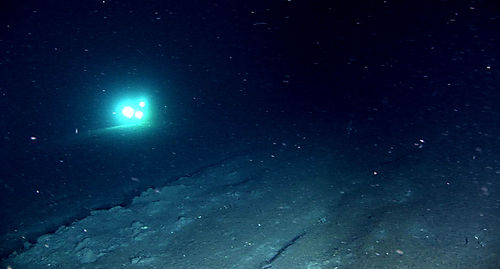
Yesterday (Thursday) morning, Michelle Ridgway and I descended in the twin subs for our expedition’s penultimate dive on Pribilof Canyon.Michelle’s lights shone as tiny pinpoints in the distant green as the light from above slowly vanished and the cold darkness of Pribilof Canyon enveloped us.I had a rare moment amid the descent’s harried series of checks and radio transmissions to reflect on where I was, and Michelle’s lights reminded me of how tiny we were, trying to comprehend an enormous, complex tapestry in the darkness armed with only a pen light. But on this dive, some of those complexities began to tell a story. Read more
https://oceandoctor.org/wp-content/uploads/2007/08/trawl-scar-bering-sea-2007_small.jpg269500Ocean Doctorhttps://oceandoctor.org/wp-content/uploads/2015/04/Ocean-Doctor-Logo_w340.pngOcean Doctor2007-08-04 02:54:562012-08-01 11:29:28Alone in the Dark with a Pen Light
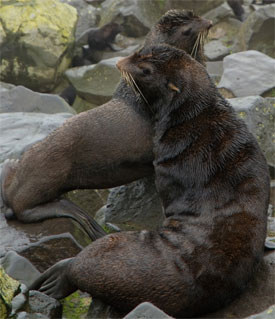
The Esperanza crew had an opportunity for a brief shore leave on St. Paul Island on Friday (August 3) before steaming north to Zhemchug Canyon. On St. Paul, they visited a fur seal rookery. Populations of fur seals are down dramatically. (Photo by David E. Guggenheim)
Continued favorable weather and few mechanical problems means that the team aboard Esperanza has been able to complete 14 manned submersible dives at Pribilof Canyon. On Saturday (August 4), Esperanza arrived at Zhemchug Canyon to explore this, the largest undersea canyon in the world, much larger than the Grand Canyon. Within the first few minutes of the deepest ROV dive yet, more than 3,000 feet down, the team discovered corals, including pink “bubblegum” corals along with other soft corals.
Earlier, during the final dives at Pribilof Canyon, the team documented numerous corals, but also evidence of extensive trawling damage in the area.
The Esperanza is carrying two manned submersibles, a remotely-operated vehicle (ROV) and an international research team to the Bering Sea for a three week survey of Zhemchug and Pribilof Canyons,to map and document deepwater corals living at depths of more than 1,000 feet. The expedition was conceived of and is being led by Greenpeace.
https://oceandoctor.org/wp-content/uploads/2015/04/Ocean-Doctor-Logo_w340.png00Ocean Doctorhttps://oceandoctor.org/wp-content/uploads/2015/04/Ocean-Doctor-Logo_w340.pngOcean Doctor2007-08-03 23:01:572012-07-28 15:20:43Esperanza Now at Zhemchug Canyon, Largest Underwater Canyon in the World



 I awakened at 4am in my bunk to something strange. The ship was still. After enduring two days of pounding seas and gale-force winds, we had at last arrived at the island of Unalaska and were nearing the port of Dutch Harbor. A few hours later, juggling my cameras, I tried in vain to capturethe profound tranquility of that early Alaskan morning as dawn’s gentle glow painted small swaths of green across the surrounding mountains atop a canvas of deep blues and grays.An incredible journey was nearing its end, and I was reluctant to let go. So was the wildlife. In a moment, the morning silence was replaced by shrieks from the deck below. They were shrieks of joy as once again we were surrounded by whales as a pod of humpbacks divided itself evenly and passed closely along both sides of us, filling the morning air with their spouts and flukes.